
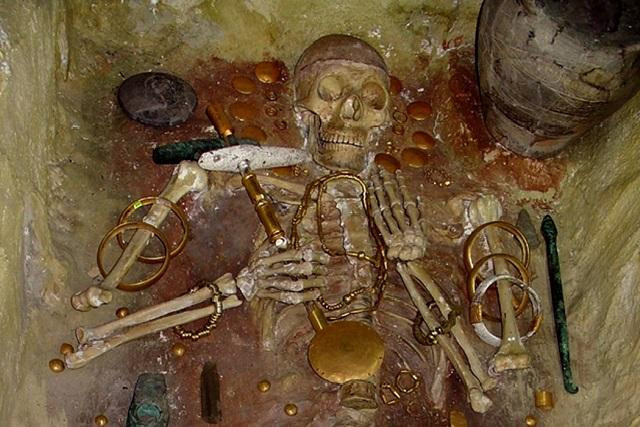
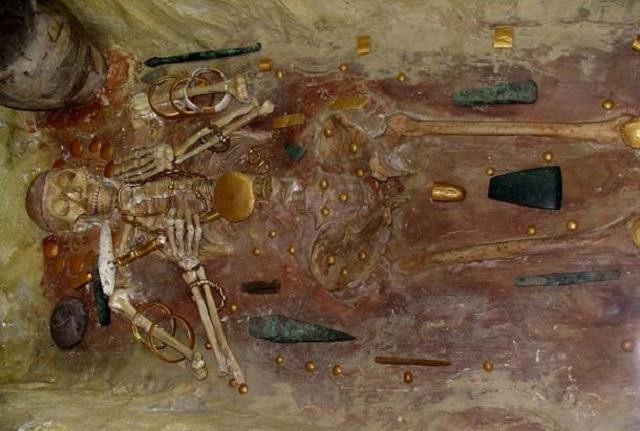
Archaeologists call this particular tomb Tomb 43. This tomb contains the remains of a man who was buried with the same huge “treasure”. Accordingly, a lot of gold was found in this man’s tomb, even his penis was covered in gold.
This amount of gold is even larger than the total amount of gold that archaeologists have discovered in the Bronze Age. This shows that the man had a very high position in society when he was alive. So who was this rich man and in what society did he live?
 |
|
The man was buried in an ancient tomb filled with gold, even his penis was covered in gold. |
Most people have heard of the great civilizations of Mesopotamia and Egypt. But few have heard of the mysterious civilization that emerged on the shores of a lake near the Black Sea about 7,000 years ago: the Varna civilization.
A huge Bronze Age necropolis discovered near the present-day city of Varna and Tomb 43 provide a glimpse into the mysterious Varna civilization.

The Varna civilization is considered to be an incredibly advanced civilization, older than the empires of Mesopotamia and Egypt. Notably, Varna was the first civilization known to have crafted gold artifacts.
Varna is now home to the largest known prehistoric necropolis in Southeast Europe, reflecting a rich cultural heritage, complex rituals, an ancient belief system, and the ability to produce sophisticated, expertly crafted goods.
This is considered the cradle of civilization in Europe, as its influence spread throughout Europe for thousands of years to come.
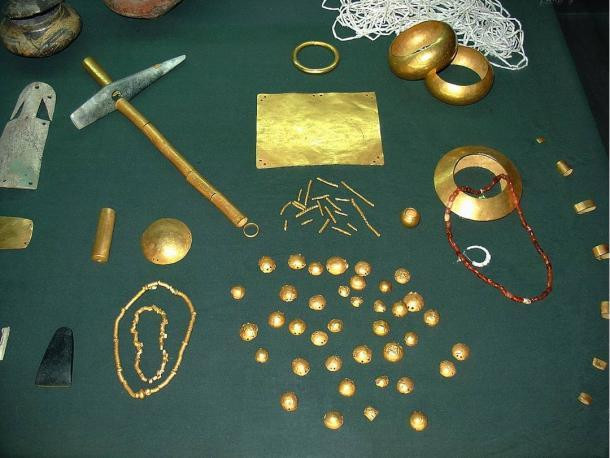
Evidence shows that from 4600 to 4200 BC, the goldsmith trade began to appear and flourish in Varna.

Increased trade allowed metallurgists to accumulate enormous wealth, and a social divide quickly emerged with metallurgists at the top, followed by merchants in the middle class and peasants in the lower classes.
Amazing discoveries at a nearby cemetery also suggest that Varna had a ruler or powerful head.
 |
|
All the gold was discovered inside other graves in the cemetery. |
In this cemetery, although many elite ancient tombs were discovered, there is still one tomb that is more special than the others – tomb 43.
Inside tomb 43, archaeologists discovered the remains of a high-ranking male who appeared to be a ruler or a chief of some sort. The amount of gold buried with this man is proof of that.

The man, also named Varna, was buried with a scepter – a symbol of high authority or spiritual power. More uniquely, the man also wore a solid gold sheath over his penis.
However, until now researchers have not found the exact identity of the man.
Marija Gimbutas, an American archaeologist, said that by the end of the 5th millennium BC, the once-mighty Varna civilization began to disintegrate. It is hypothesized that the collapse of the Varna civilization was due to a combination of factors including climate change, which turned large areas of arable land into swamps and ponds, as well as attacks by steppe warriors.
Although the Varna civilization left no direct descendants, it left behind many lasting legacies and set the stage for the emergence of subsequent civilizations across Europe.
Their metallurgical skills were considered to be unmatched anywhere else in Europe and indeed the world. Their society displayed many of the characteristics of a developed and advanced civilization.