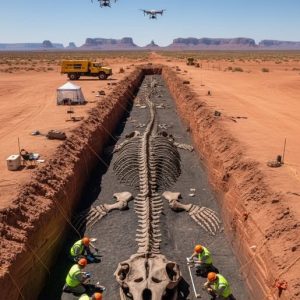

A remote desert canyon has erupted into the center of worldwide attention after researchers documented the colossal remains of what appears to be an ancient, previously unknown creature. The excavation team, initially conducting a geological survey of the canyon’s stratified cliffs, uncovered the skeleton partially embedded in hardened sediment layers, its enormous vertebrae and elongated limbs exposed beneath centuries of wind-sculpted sandstone. Preliminary images show the bones arranged with an eerie level of completeness, raising questions about whether the creature died naturally in the canyon or was deposited there under extraordinary circumstances. The site’s extreme isolation—accessible only through a narrow, winding crevice—has added to the mystery, prompting an urgent multinational response as scientists scramble to analyze the find before environmental or human interference can compromise the evidence.

The discovery has ignited fierce debate across the scientific community. Paleontologists argue that the remains may represent a long-extinct species adapted to ancient desert environments or transitional ecosystems that no longer exist. They note that the skeleton’s proportions differ sharply from any known megafauna, suggesting a species that challenges established evolutionary timelines. Archaeologists, meanwhile, point to surrounding sediment formations and rock engravings as potential clues to the creature’s age and the region’s prehistorical significance. However, skeptics urge caution, warning that natural deformation, mineralization, or even unknown geological processes could distort the appearance of the bones. Some experts have gone further, raising concerns that the discovery could be a sophisticated fabrication engineered to provoke viral reaction—citing the dramatic placement and near-perfect articulation of the skeleton as possible indicators of human intervention. Until radiometric dating, structural analysis, and compositional studies are complete, definitive conclusions remain elusive.

While scientific teams rush to secure and analyze the skeleton, public discourse has exploded into a global firestorm. Social media platforms are flooded with theories ranging from suppressed evidence of forgotten species to claims that the discovery exposes forbidden chapters of ancient history deliberately hidden from the public. Calls for transparency have intensified after local authorities declined to release detailed reports, citing the need for controlled research and site protection. Critics argue that this silence only fuels suspicion of a cover-up, while cultural historians note that desert canyons have long been linked to mythic narratives involving giant beings, vanished civilizations, and primordial creatures. International research groups are now pressing for independent access to the site, warning that global interest demands scientific openness rather than restricted investigation. Regardless of its final classification, experts agree that the discovery has already become one of the most contentious and captivating archaeological events of the decade. As the world awaits conclusive findings, one question continues to dominate global conversation: does this desert skeleton represent a groundbreaking chapter of ancient life—or a mystery engineered to challenge our understanding of the past?