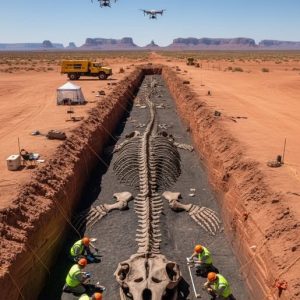

A remote desert plain has become the center of worldwide attention after researchers uncovered what appears to be a fully intact giant skeleton—one of the most dramatic and polarizing discoveries in recent archaeological memory. Early documentation shows an immense ribcage, elongated limb bones, and a massive skull lying in pristine alignment across compacted sand, suggesting minimal disturbance since the moment of burial or collapse. The clarity and scale of the remains have stunned experts on site, who have begun meticulous measurements and imaging to determine the skeleton’s age, composition, and possible origin. The stark desolation of the landscape surrounding the discovery adds even more weight to the unfolding mystery, prompting urgent calls for formal investigation and site protection.

Scientific opinion is sharply divided as debates erupt across academic institutions and public forums. Some paleoanthropologists argue that, if verified, the skeleton could represent evidence of an undocumented hominin species or an ancient population with physiological traits radically different from anything previously recorded. They emphasize that the desert environment is capable of preserving organic material under rare conditions, making the find theoretically possible. Archaeologists examining sediment layers around the skeleton have proposed hypotheses ranging from ceremonial burial to sudden environmental catastrophe. Yet skeptics warn that the scene may not be what it appears: critics highlight the risk of staged discoveries engineered for viral impact, pointing to the unusually intact alignment of the bones as a potential red flag. Others caution that geological processes, mineralization, or erosion can distort bone size, creating illusions that fuel sensational interpretations.

As images of the skeleton dominate global headlines, authorities have moved to secure the site and restrict access pending controlled excavation. Teams specializing in osteology, environmental dating, mineral analysis, and forensic documentation are preparing to conduct comprehensive testing to determine whether the remains are genuine, altered by natural forces, or intentionally arranged. Meanwhile, social media has erupted with a tidal wave of speculation—ranging from claims of ancient giant civilizations suppressed by official narratives to accusations of modern scientific manipulation. Cultural historians note that myths of giants appear across countless ancient traditions, adding symbolic power to the discovery regardless of its ultimate explanation. Whether the skeleton proves to be a groundbreaking revelation or a sophisticated illusion, the find has already ignited one of the most intense archaeological debates in recent history. As the world awaits definitive results, one question continues to dominate global conversation: what colossal truths—or deceptions—are buried beneath the shifting sands?